Showing posts with label studio visit. Show all posts

Thursday, August 2, 2012

Studio Process: The Tools I Make

As an extension of my painting practice, I make my own tools with bits and scraps from the studio, what others might consider garbage. Sometimes, I will carry trash into my studio from my city visits and utilize these scraps in my work. 
Wire tool hanger.

My Tools-Close Up.

More Tools-Close Up. This one is a favorite!
For me, the end of a used roll of tape and a bit of shelf liner becomes a tool with which to make ben-day type dot patterns. A scrap of wood with nails embedded into it becomes a paint tool or a scraper. Old erasers, plastic pieces of pipe, buttons, pennies, bike chains, and many other items that would normally end up in the bottom of a junk pile, are all fodder for possible use as tools or as a layer of texture within my work. 
Some well used tools and some newly created tools.

General Studio Shot.

Studio view.
The possibilities for turning odd materials into painting surfaces or patterns serve my purposes well. I explore territories of structure and disorder, what is noticed and what is ignored. My paintings allude to maps, communities, architecture, house plans, and neighborhoods. 
Fire extinguisher for safety and a red box full of scrap papers.
In progress work.
Suzanne Gibbs, 2012. Wax Paper Collage.
 Thanks for viewing. Have you aver made tools to work with that you could not buy at a store? I'd love to hear your story.

Tuesday, July 17, 2012

Pay Attention To What You Pay Attention To.

Clearly, where we put our focus is what we will materialize in our life. I am finding that in grad-school everything is what we make of it each day. What we choose to pay attention to manifests the results. Post-grad work will be a plethora of opportunities–or at least I sure hope so! 
Suzanne Gibbs, 2012. Linear Collage. Gesso, acrylic, gouache, tape, paper, and canvas on canvas.

Myths that I hate, Artists are:

poor.
loners.
weird.
replaceable.
crazy.
odd.
unreliable.
 

A Can Do Focus

The steps, as I see it, that can be taken to bust the myths.
Work the Art.
The business of art.
Work ethic.
Resiliency.
100% supportive people.
Understand and leverage the power of ideas.


I took the time to look up the artists that I feel are best symbolizing the above mentioned myth busters. Following is what I came up with.

Work the Art

“I follow my instincts and work on the projects that interest me, whether writing, painting, blogging...or something else. No one can anticipate where each project will lead – you just have to embrace the not-knowing.” Sharon Butler, 
Author of:
Two Coats of Paint and other publications, Artist and University Professor.
Sharon Butler, Untitled (detail), 2012
pigment, binder, pencil on unstretched linen
48 x 60 inches

The Business of Art 

“All my work is about what we want from art, what collectors want, what artists want from collectors, what museum audiences want.” Andrea Fraser, Artist, Performance Art, Writter, University Instructor
Andrea Fraser.

Work Ethic 

“I am the head of a team, a coach, a producer, an organizer, a representative, a cheerleader, a host of the party, a captain of the boat, in short, an activist, an activator, an incubator.” Gabriel Orozco, Artist and business owner, lives in two countries.
Gabriel Orozco. Yielding Stone (Piedra Que Cede), 1992. Plasticine and dust.

Resiliency

“I was supporting myself, but nothing like the guy painters, as I refer to them. I always resented that actually.. we were all getting the same amount of press, but they were going gangbusters with sales.” Cindy Sherman, Artist, Performmance photographer.
Cindy Sherman.

100% Supportive People

“I think about, the economics of collaboration.” Alexandra Grant, Painter, Collaborative Artist, Business Owner
Alexandra Grant. Studio Shot.

 Power of Ideas

“I just wanted to find out where the boundaries were. I've found out there aren't any. I wanted to be stopped but no one will stop me.” Damien Hirst, Artist, business owner, celebrity.
Damien Hirst.
 

Focus on a career in Art:

Work the Art.
The business of art.
Work ethic.
Resiliency.
100% supportive people.
Understand and leverage the power of ideas.
 
We all have the potential to be our own brand of artist.

My brand of artistic career contains the following:
Making Art
Teaching Art
Writing about Art


– And for some shameless self-promotion, if you are reading this blog thank you. If you really like the content consider subscribing (use the button to the top right). Alternately, if someone shared this post with you and you want to see more, go to my Blog at:
 
http://suzanneutaskigibbs.blogspot.com/
 
Most importantly, what did I leave out that any one of you might find highly relevant? Please share in the comments section below.

Tuesday, July 10, 2012

Gallery Visit–OCCCA, Maldita Frontera

I recently took my second visit to the OCCCA Gallery. My first being in June of this year. I was not disappointed. Maldita Frontera opened on July 7, 2012. The show ends on July 28, 2012. The event was held during the Santa Ana 84th Anniversary celebration of the Santora Building.
Ramon Carrillo, detail.

The meaning of maldita frontera is: damn boarder or horrid boarder. There are so many times when I walk into an exhibition and think to myself, yea well so what? This exhibit tries to ask the viewer to care, to look deeper, to think. The execution of the art varied from excellent quality to somewhat rougher executions. One begins to see that this topic should be given more time and consideration.

Does the show do enough? Is there enough content presented to bring attention to the realities and horrors of the boarder between the United States and Mexico? The show walks the tight rope of informing and not blaming. I should mention that all of the gallery tags are in Spanish first, then English. A nice touch allowing Spanish first.

My teen aged children who viewed the work with me felt the show was about prostitution and drug trafficking. They rely on what they see without reading labels in a gallery. This tells me that the images could be read on multiple levels.

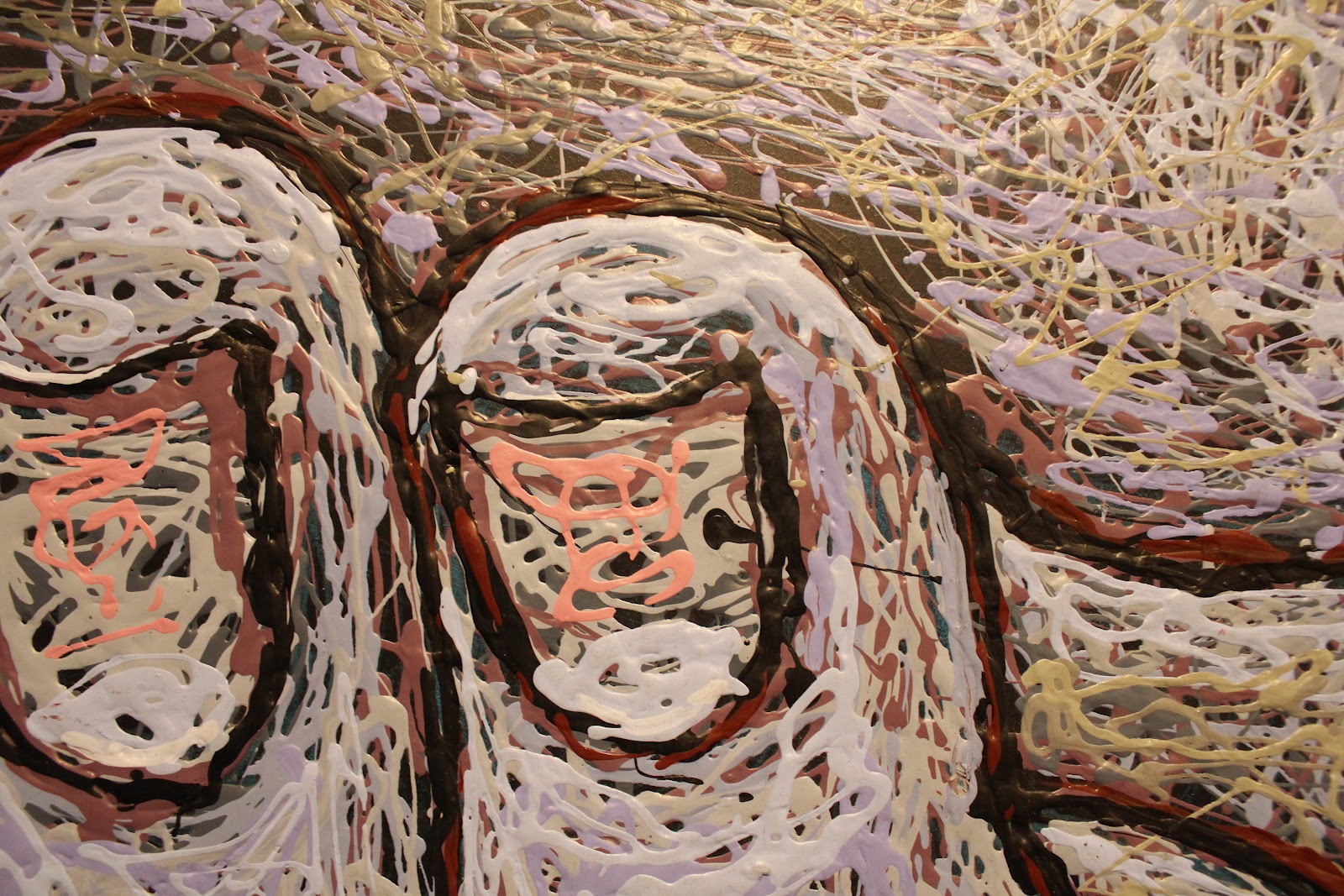
Below is a gallery shot of the work of Ramon Carrillo. The execution was of layers and layers of dripped acrylic paint to create the image. The paint kind of binds on itself just as the topic of the US/Mexico boarder is complex and multifaceted. The US and Mexico are bound to each other and we need each other. Similar to how each layer of paint holds up the next layer and creates form.

Ramon Carrillo.

Ramon Carrillo, 2009. Human torso hanged with metal hook.

Pablo Castaneda, 2012. Orson Wells/Thirst for Evil, according to Orson Wells. Detail.

Many people at the opening.

Pablo Castaneda full view. Almost big enough to make me think of Guernica by Pablo Picasso.

Eduardo Kintero, 2012. Ceramic on Panel.

Eduardo Kintero.

Eduardo Kintero. With a translation by Suzanne, the author of this blog post:
I need some help. My boy went to the other side. He went for a few dollars.He did not return.

Eduardo Kintero, 2012.

Across the street I visited another open studio/gallery.
Jose Quant.

Jose Quant.

Jose Quant.
This painting stopped my son and I in our tracks. It was hung in a stairwell, so I was unable to get a straight picture of it. Still, remarkable use of paint and texture.

Marinus Welman, The Execution. 78 x 64 inches, oil on canvas.

Marinus Welman, detail.

Marinus Welman, detail.

Monday, July 9, 2012

Encaustic Artists Take Note: Wikipedia is Weak

As a budding encaustic artist I cannot help but notice that there is not enough information in our on-line encyclopedia to encourage full understanding of this most wonderful and versatile medium. We must keep working to bring more information about this wonderful medium to the public.

Suzanne Gibbs, 2012. Fives. Encaustic on paper sheets.

Suzanne Gibbs, 2012.
If you are an experienced encaustic artist, what would you add to the Wikipedia Encaustic information? Please share.

Saturday, July 7, 2012

Jackie Bell Johnson–Artist Interview

I am so excited to present to my readers my first interview. I hope to do many more. Jackie Bell Johnson is a peer and a classmate at CGU. Her works are sculptural in nature as well as investigations of installation. 

I presented her with a series of questions ahead of the interview and then we talked in her studio as she worked. For me it was a treat to take the time to listen to her–usually we banter about all sorts of topics. This time I focused on what she had to say, or well...I tried harder to do so.

When did you consider yourself to be an artist?

Somewhere in the middle of high school. Before that, I considered the title to be reserved for professionals who show in galleries and sell. A few years into high school and studying art I gained more confidence in my own abilities and gained a broader idea of what an artist is.


After school, where do you plan to locate your studio? Do you have a plan for how you’ll set up?

Immediately upon graduation I'll be moving everything into my garage (which acts as a partial studio now). Once I land enough income to be able to pay my loans and afford additional rent for a studio, I'll aim to get something in East LA. I want to be close to the art scene in Culver City, but I don't want a horrible commute. East LA is a good compromise, and it has many empty warehouses and scrap metal yards.

Does your studio location influence your work?

Being close by means more time in the studio less time driving.


Describe a typical day of work.

What's that? My day is dictated first by how I'm feeling (I have a bad shoulder). If its a good day and I have a large chunk of time I'll work on something more complicated and physically taxing, usually metal or wood. Otherwise, I'm doing something more crafty: painting or weaving.

What materials do you most often use?

Wood and metal are staples in my practice. Wire, linear wooden objects (like chopsticks or toothpicks), and plastics have started to appear a lot. 


What is your most coveted studio furniture piece?

Probably the loft I built over my desk. 

How about this tool rack?

Oh, that...I made it in undergrad, it's just a pallet.


What unique tools or devices do you use which are critical to your creative process?

My hammers, I have a collection of jewelry, watchmaker, and antique hammers. Along with that is my hammering table; I keep it down in the school's metal shop. It's a table with a thick butcher block top which I've mounted a few vices and stake mounts too. The stakes are used to hit sheet metal over to shape it. 

When I was about 14 I asked my Mom to take me to Baltimore for my birthday. I had seen the "big city" driving by it, but I had never been in it. She took me to a bead shop–the best bead shop anywhere.It's called Beadazzled and it is still there. My Mom allowed me to make a necklace while I was there. What I really loved and still have is the hammer and anvil she bought me that day. One is an anvil is a miniature one and all rusty. The hammer is a chasing hammer. Both of them are in my home studio.


Can you tell me about an item in your studio that has significant meaning to you?

My jewelers bench is pretty important to me. It reminds my of all the hard work I've done so far (undergrad was pretty tough), and the importance in craftsmanship in art. Beyond that I keep a collection of antique metal keys. They are a reminder of the "keys to success," as a former boss told me when she gave me the big one hanging at the top.


Describe your project schedule.

I'm working on a lot of things simultaneously and don't really schedule things to be done. I might focus on one or two pieces because of a deadline, but nothing is ever self imposed.


Where/when do you let ideas percolate?

When I least expect them. I start daydreaming while I'm looking at something and I see it change/evolve in my mind. I draw it out and it tends to change even more. I usually sit on the visual for a bit and then I'll randomly see something that sparks a solution for how to build it. Sometimes that takes a month or two.

How often do you clean your studio?

I don't clean. I'll rearrange things and sweep and that's about it.


How do you title your work?

I try to avoid titles that add to the piece. The art should give you everything you need to know, instead of the title explaining it. So I usually use vague yet literal descriptions as the title. Using "Untitled" is a cop out.

Do you have or plan to have assistants?

Budget willing, I absolutely would. For example, I am not the best at wood but still would like to have my wood pieces match the craftsmanship of my other work. Hiring a skilled carpenter would be better than what I'm doing now which is building my own work. I've been doing a lot of labor intensive pieces, and for some of them it would be nice to have some help, just to speed things along.

Have you or would you work for an other artist?

I would like to have the opportunity, mainly because it would give me ties to an artist that is making it, and all the connections they have made in the process. To learn on an intimate level how they function as artists and how they execute their work would be awesome. I would worry about their work influencing mine too much, and so I would be very cautious about working there too long.

Right now I am working with Craig Deines at Mt. SAC. I am learning about classroom administration stuff from him, like grades and attendance. I also admire the intense rigor he expects of all his students. The philosophy of no excuses. Everyone is working to B or A level.

Tell me your artist motto, manifesto or creed.

1. You don't need to fully understand what you're doing, but you need to accept it. Embrace it. It's what makes you you.
2. The idea determines the materials


Any advice for other artists?

Be serious about your career, your studies and your art, but make sure your practice, art, and self are full of humor and playfulness. Notice how art is on both sides of that one?

Any question I should have asked? 

What is your 2 sentence elevator speech?
Do you have any influences, interests, or inspirations for your work that others might find surprising?

Ok so, what is your 2 sentence elevator speech?

I am a sculpture, I use metal and other things. I work to combine industrial man made products and an organic sensibility to see how they correlate while still making a cohesive piece.

Surprise me: influences, interests, or inspirations.

Tori Amos, she's a piano player. I find her work beautiful, although I am aware others might not. She made it ok to have strange sounds coming from a woman. 

Madeline L'Engle, an author. I love reading her books, and not just A Wrinkle in Time.

I am interested in layers in music and electronica.

Inspiration?

I cannot pinpoint inspiration. I do like watching people do things, like workers at construction sites or gardeners. I learn from that.

School here at CGU has inspired me to let go of perfection. I am making pieces that I visualize in my head, without the drive for perfection. Later with money and paid labor, I can revisit some of the work I am making now.

To learn more about Jackie:

Jackie - Thank you so much for your time!

Friday, July 6, 2012

Sculpture Installation and Studio Details–Matt Hillseth


June was a month of locked Gallery doors at CGU Art. This week we have some action starting up again in the building. I am so glad to have walked by this installation of sculptures today.


 Matt Hillseth has been working.
 Yes, I did lie down on the floor to get a different perspective.


 Here is a sneek peak at  Matt's studio.
 Not sure what this is...
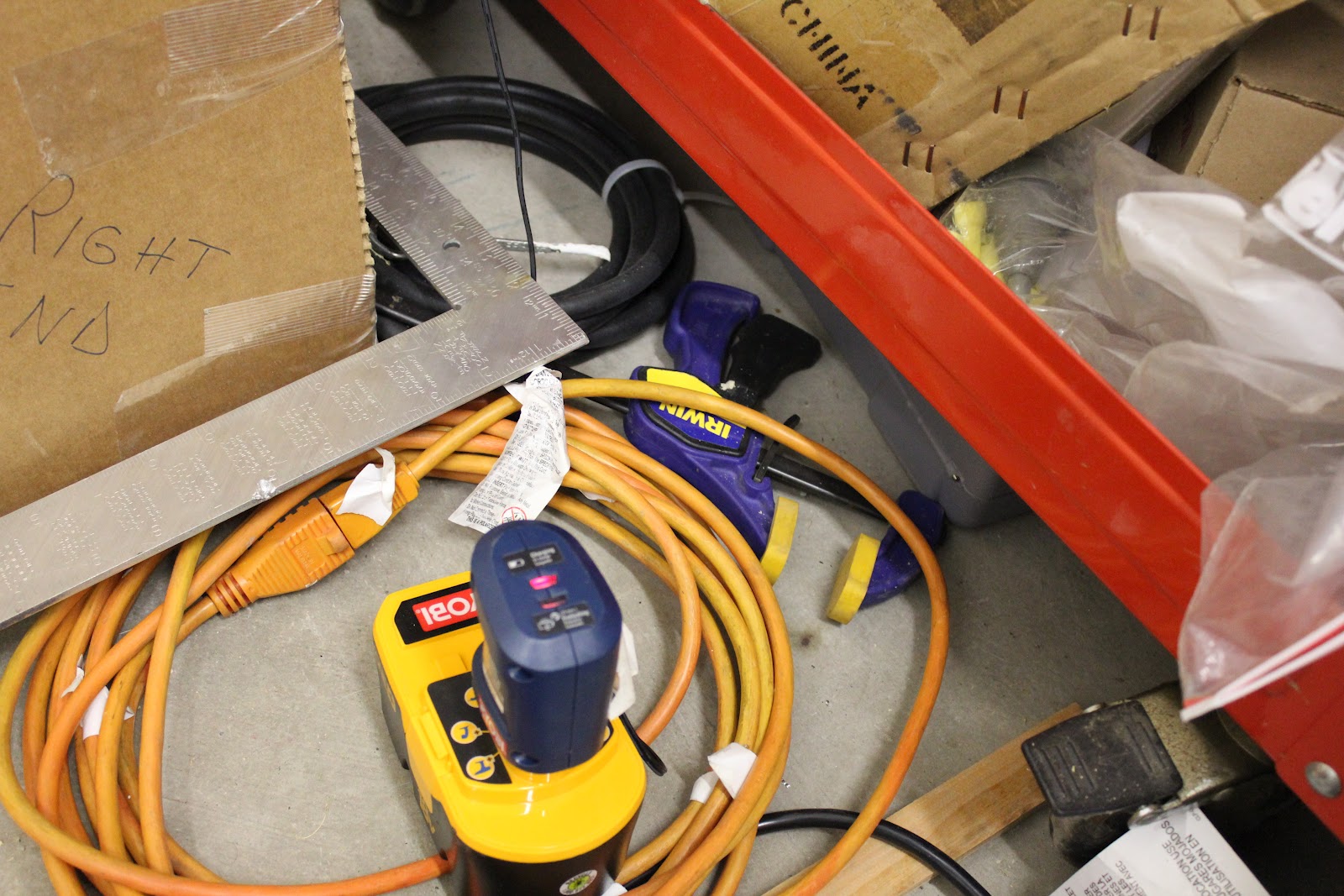
The tools of the trade. Mess of the trade.
This mini piece caught my eye. I wonder if it will go bigger one day. It doesn't have to, I like it small.


Does his work provoke any thoughts for you?